Keyboard Benches and Stands: The Accessories Digital Piano Players Get Wrong
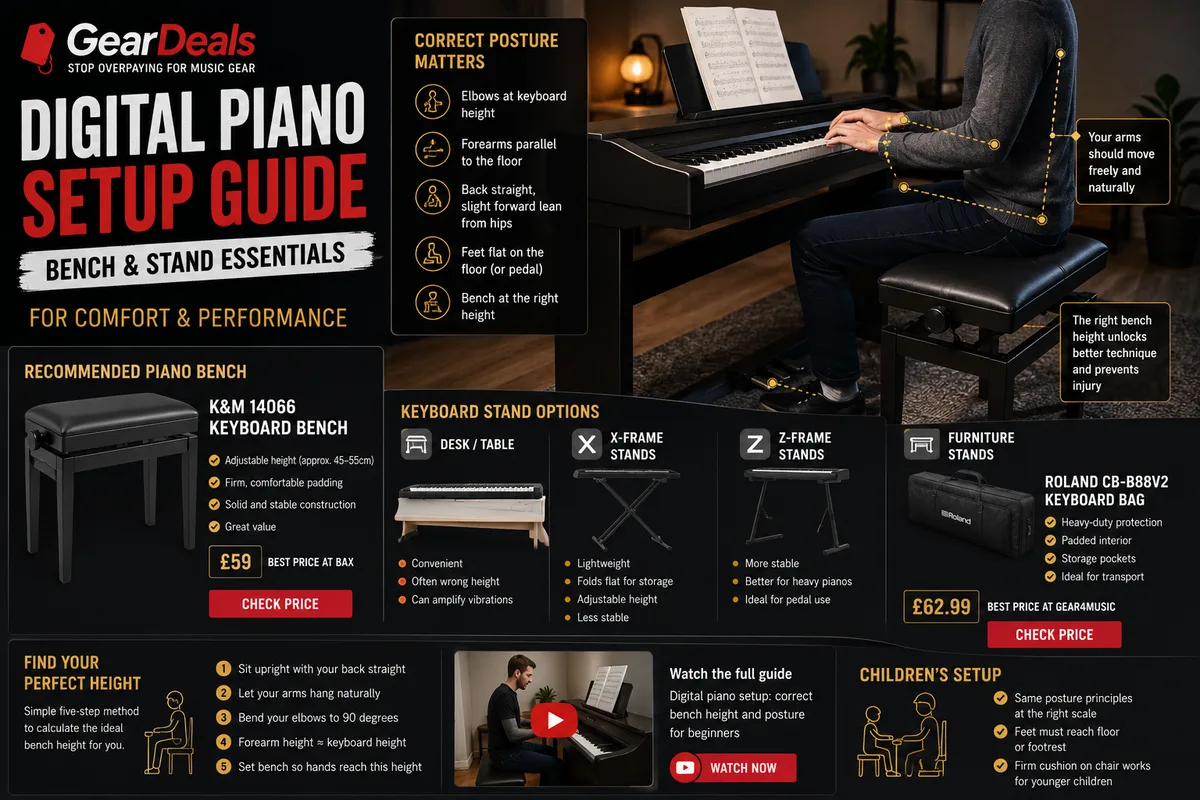
Most digital piano buyers spend everything on the instrument and nothing on the furniture. A good bench and stand affect your posture, comfort and technique development more than you might expect.
You have spent several hundred pounds on a digital piano and plugged it in. It sits on your kitchen table at an awkward height, and you perch on a dining chair that forces your arms into an angle that would horrify any piano teacher. Six months later, your wrists hurt and you are not sure why.
Proper piano posture is not an optional refinement. It is the foundation of technique and injury prevention. The right bench and stand are as important as the piano itself for anyone serious about learning or playing.
The correct sitting position
Before choosing furniture, understand what you are trying to achieve:
- Your elbows should be roughly at the height of the keyboard, with a slight downward angle from shoulder to finger
- Your forearms should be roughly parallel to the floor, maybe slightly angled down toward the keys
- Your back should be straight, not curved - slight forward lean from the hips is fine, slouching is not
- Your feet should be flat on the floor (or on the pedal), not dangling
- The bench should be at the correct height so that sitting with straight posture puts your hands in the right position at the keyboard
This is only achievable with a bench that is at the correct height for your body. Kitchen chairs and sofas do not adjust. A proper adjustable piano bench does.
Piano benches: what to look for
Piano benches come in two main types: fixed height and adjustable. For most adults, an adjustable bench is the right choice because it can be set to the exact height that your posture requires, regardless of how tall or short you are.
Key features:
- Height adjustment range - Most adjustable benches adjust between roughly 45cm and 55cm. Check that this range covers the height that works for your body and keyboard combination.
- Padding - Thicker, firmer padding is preferable to thin or very soft padding for extended playing. Very soft padding allows your position to shift as the foam compresses.
- Stability - The bench should not wobble when you shift your weight. Check that the adjustment mechanism locks securely.
- Width - Standard single benches are around 60-70cm wide. Duet benches are wider for two people. Most solo players do not need a duet bench.
The K&M 14066 Keyboard Bench is a well-regarded adjustable bench at a sensible price. It is sturdy, adjusts over a useful range, and the seat padding is firm enough for extended sessions.
Keyboard stands: types and trade-offs
Digital pianos can sit on a desk or table, on a dedicated furniture-style stand, or on an adjustable X-frame or Z-frame stand. Each has genuine advantages and limitations:
Desk or table placement - Convenient but often the wrong height and puts the keyboard on a resonant surface that can amplify vibrations and affect the built-in speaker sound. The most common setup for beginners; not ideal for long-term use.
X-frame stands - Lightweight, fold flat for storage, and adjust in height. The most portable option, suitable for keyboards that are moved between locations. Not the most stable for heavy instruments and can wobble during vigorous playing.
Z-frame (double-X or A-frame) stands - More stable than X-frames, often with wider legs. A better choice for heavier digital pianos or for players who use the sustain pedal vigorously.
Furniture-style stands - Many digital piano manufacturers sell matching wooden or MDF stands that give the instrument a more furniture-like appearance. Stable, attractive, but not portable and more expensive.
The height calculation
To find the correct bench height for your body:
- Sit upright with your back straight
- Let your arms hang naturally at your sides
- Bend your elbows to 90 degrees
- The height of your forearms from the floor is approximately the correct keyboard height
- Set your bench so that sitting in correct posture brings your hands to that height at the keyboard
This sounds like more effort than it is. Once you have found the right position and set the bench, you do not need to adjust it again unless your keyboard changes or someone else uses the bench.
Do children need a different setup?
Children need exactly the same principles applied at a smaller scale. A child's feet should reach the floor or a footrest - dangling legs create instability and make pedal use awkward. The bench height should allow the same arm angle described above.
Many piano teachers recommend children sit on a firm cushion on a regular chair until they are large enough to sit correctly on a full adult bench. This is a practical compromise that costs nothing and works well enough for younger beginners.