● Live Data
Soma Laboratory · Keyboards and Synths
Soma Laboratory SoMa Laboratory Lyra-4 4-Voice Organismic Anal...
£420.08Fair Value1 stores tracked
Buy Signal
Price near historical average — neutral outlook
Confidence: 50/100
RSI (14)
—
Need 15+ data points
Volatility (ann.)
—
Need more data
30d Momentum
—
Need 30+ data points
Price Position
—
No 90d range data
EMA 20
—
EMA 50
—
Need 50+ data points
90d Low / High
—
30d Forecast
—
→ Stable
Product Fundamentals
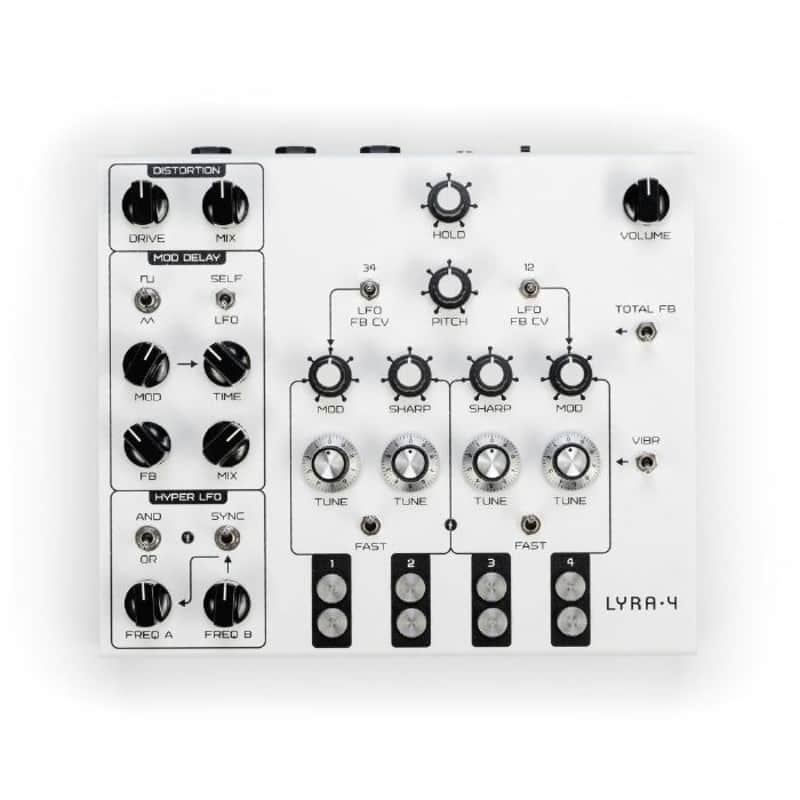
- Introducing the revived version of LYRA-4 organismic synthesiser, the younger sister of the famous LYRA-8. "Organismic" means that LYRA uses some principles that lie in the base of living organisms. The way how LYRA's modules interacting between each other and the behaviour of the instrument resembles a live conversation. It's smaller and weighs less but is equally rugged in design, and still packs a lot of punch. This makes it easy to fit in a backpack and perfect for taking the LYRA sound on the road. And playing two LYRA-4s can actually sound very different than just one LYRA-8. LYRA-4 is based on four generators, which will be referred to as voices. Their design is not like a traditional subtractive synthesis VCO. Instead of having a linear or logarithmic dependency on control voltage, they resemble the tone generators in old electric organs. Hence the use of the term "voices" instead of "VCOs". Lyra uses non-linearity a lot, and the voices are constructed in such a way that allows for non-linearity to express itself. The voices are divided into two pairs (12
- 34), creating tree-like structure. The voices can function either in an electric organ mode or in an FM synthesis mode with each of the voices and its envelope acting as a separate FM operator. The voice's impact on FM synthesis will decrease along with the decay of its envelope. LYRA-4 also has the next blocks: The HYPER LFO is a complex low-frequency generator, whose waveform is synthesized from two simple LFOs by summation or multiplication of their frequencies. It also has a sync mode. The LFO can modulate the selected pairs of voices and the MOD DELAY. The MOD DELAY consists of delay with feedback. The delay has a unique possibility of self-modulation where the output signal modulates the delay sample rate, creating cool effects. The DISTORTION is last in the chain, after the delay. It enables the delay to also influence the distortion. For all its experimental character
- LYRA is a professional instrument. Its output dynamics and frequency response are balanced and ready for a live performance or studio recording without any additional processing. Specifications Max output voltage: 2 v 0-to-peak Output connector: mono 6.3 mm TS jack Output resistance: 10 KOhm CV DELAY: unipolar, range of 0 to +5 volt CV DELAY: 6.3 mm TS jack CV VOICES: unipolar, range of 0 to +5 volt CV VOICES connector: 6.3 mm TS jack Power supply: stabilised, +12 V
- 0.2 A, centre positive Power Consumption: 1.2 watt Headphones resistance: 6-64 Ohm Power supply: stabilised, +12 V
- 0.2 A, centre positive Dimensions: 241 x 203 x 62 mm Weight (without power supply and packaging): 1.2 kg What's included: LYRA-4 - 1 pc Power supply - 1 pc
GearDeals Intelligence · Data from 0 historical price points · Analysis is informational only, not financial advice